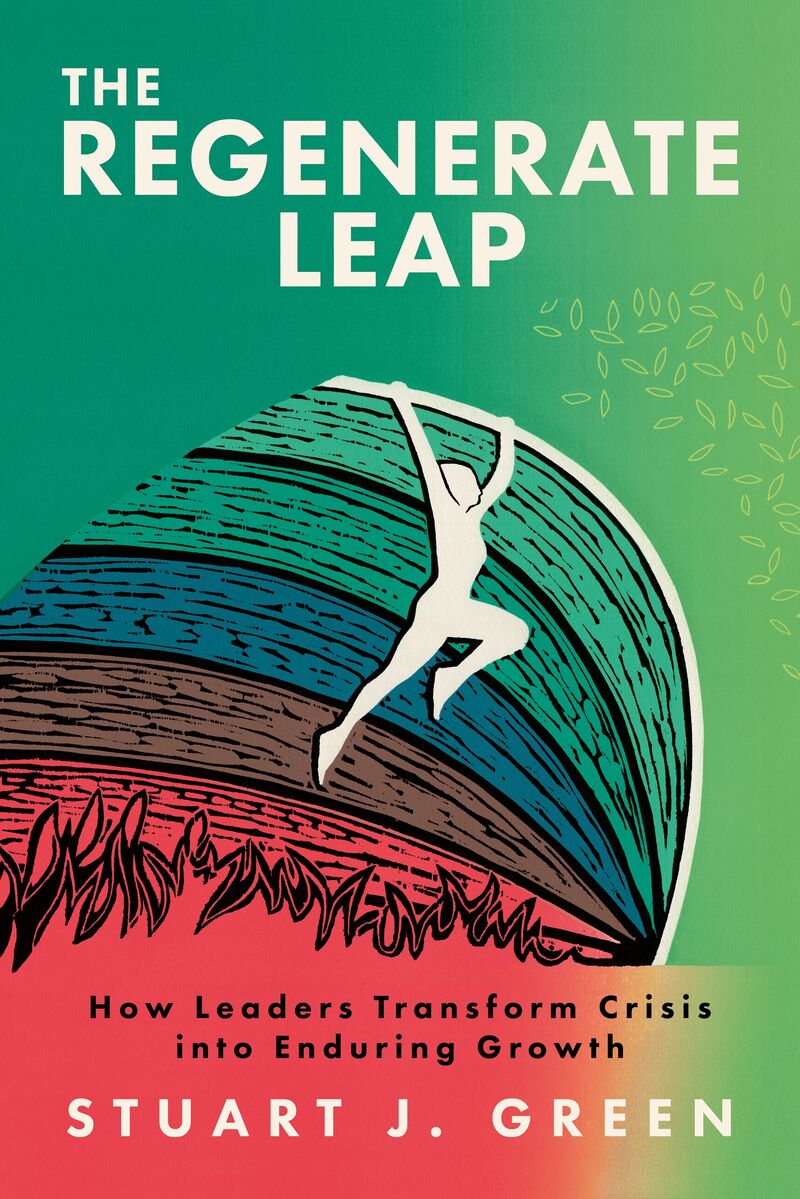
Leap forward. Grow through fire.
The book. What comes next for leaders when the previous model has structurally failed and there is no prior state worth restoring.
Drawing on three decades translating the logic of living systems for institutional leaders, The Regenerate Leap sets out why bouncing back is the wrong goal when the baseline has shifted, and what regeneration requires of boards and chief executives instead.
The Regenerate Leap is a business book for CEOs, founders, senior executives, and board members. Its subjects: crisis leadership, organisational change, business turnaround, and decision making under sustained pressure. Readers of Forged in Crisis, Undisrupted, and Conquering Chaos will recognise the territory.
The Regenerate Leap addresses one condition: the previous operating model has structurally failed and there is no prior state worth restoring. Most leadership books assume crisis has an end and that recovery means returning to normal. This book begins where that assumption fails. The baseline has shifted. Bouncing back is the wrong goal.
The book sets out the REGENERATE framework, a methodology drawn from three decades of marine systems science. Natural systems do not recover from catastrophic disturbance by restoring what was lost. They redesign around the conditions that now hold. Some systems require fire to release dormant capacity. The book translates those patterns into enforceable strategy for boards and chief executives.
Three phases, ten steps.
"The old advice to simply 'bounce back' is a recipe for extinction."
"His framework moves beyond the tired rhetoric of resilience and provides a clear, actionable methodology for genuine institutional renewal."
No. The book's position is that resilience aims to restore a prior state, and that this is the wrong goal when the baseline has shifted. The book sets out regeneration as the alternative: redesigning the system for the conditions that now hold.
No. The science is the evidence base. The book translates patterns from natural systems into decisions boards and executives already face.
The diagnostic scores the misfit between an operating model and current conditions in thirteen questions. The book supplies the methodology for acting on that score.